"After the commercial life of creative property has ended, our tradition has always supported a second life as well. A newspaper delivers the news every day to the doorsteps of America. The very next day, it is used to wrap fish or fill boxes with fragile gifts or to build an archive of knowledge about our history. In this second life, the content can continue to inform even if that information is no longer sold.
The same has always been true about books. A book goes out of print very quickly (the average today is about a year). After it is out of print, it can be sold in used book stores without the copyright owner getting anything and stored in libraries, where many get to read the book, also for free. Used book stores and libraries are thus the second life of a book. That second life is extremely important to the spread and stability of culture.
Yet increasingly, any assumption about a stable second life for creative property does not hold true with the most important components of popular culture in the twentieth and twenty-first centuries. For these-television, movies, music, radio, the Internet-there is no guarantee of a second life. For these sorts of cultures, it is as if we've replaced libraries with Barnes & Noble superstores. With this culture, what's accessible is nothing but what a certain limited market demands. Beyond that, culture disappears."
-Lawrence Lessig, "Free Culture"
Wednesday, December 8, 2010

Sunday, November 28, 2010
Possible Passage for Final Project
If you're like I was a decade ago, or like most people are when they first start thinking about these issues, then just about now you should be puzzled about something you hadn't thought through before.
We live in a world that celebrates "property". I am one of those celebrants. I believe in the value of property in general, and I also believe in the value of that weird form of property that lawyers call "intellectual property" A large, diverse society cannot survive without property, a large, diverse, and modern society cannot flourish without intellectual propertyy.
But it takes a second's reflection to realize that there is plenty of value out there that "property" doesn't capture. I didn't mean "money can't buy you love" but rather, value that is plainly part of a process of production, including commercial as well as noncommercial production. If Disney animators had stolen a set of pencils to draw Steamboat Willie, we'd have no hesitation in condemning that taking as wrong even though trivial, even if unnoticed. Yet there was nothing wrong, at least under the law of the day, with Disney's taking from Buster Keaton or from The Brother's Grimm. There was nothing wrong with the taking from Keaton because Disney's use would have been considered "fair". There was nothing wrong with the taking from the Grimms because the Grimms' work was in the public domain.
Thus even though the things that Disney took or more generally, the things taken by anyone exercising Walt Disney creativity are valuable, our tradition does not treat those takings as wrong. Some things remain free for the taking within a free culture, and that freedom is good.
We live in a world that celebrates "property". I am one of those celebrants. I believe in the value of property in general, and I also believe in the value of that weird form of property that lawyers call "intellectual property" A large, diverse society cannot survive without property, a large, diverse, and modern society cannot flourish without intellectual propertyy.
But it takes a second's reflection to realize that there is plenty of value out there that "property" doesn't capture. I didn't mean "money can't buy you love" but rather, value that is plainly part of a process of production, including commercial as well as noncommercial production. If Disney animators had stolen a set of pencils to draw Steamboat Willie, we'd have no hesitation in condemning that taking as wrong even though trivial, even if unnoticed. Yet there was nothing wrong, at least under the law of the day, with Disney's taking from Buster Keaton or from The Brother's Grimm. There was nothing wrong with the taking from Keaton because Disney's use would have been considered "fair". There was nothing wrong with the taking from the Grimms because the Grimms' work was in the public domain.
Thus even though the things that Disney took or more generally, the things taken by anyone exercising Walt Disney creativity are valuable, our tradition does not treat those takings as wrong. Some things remain free for the taking within a free culture, and that freedom is good.
Wednesday, November 17, 2010
Saturday, October 30, 2010
Second Assignment Edited:Screencast
Convergence in Culture
Twitter, launched on July 15, 2006, is a social media site where you can post small messages called tweets. A Twitter user can write up to 140 characters telling their “followers” their current status, or their current thoughts. According to Twitter, “whether you tweet 100 times a day or never, you still have access to the voices and information surrounding what interests you.” Twitter is based on the user’s needs and wants; you do not have to follow anyone but rather use it to obtain the information that interests you. Today, Twitter is one of the top ten most visited websites, and at the end of 2009 two billion tweets were posted every quarter, according to Wikipedia. Once a small website, Twitter has now surpassed most websites on the Internet, and now has become a cultural phenomenon.
Twitter, like predecessors before it, gives the world the opportunity to participate with friends, or public figures of today. Twitter is solely based on human participation, without participation the website would be nothing. When one posts a status, the possible recipient of the status has the choice to respond to the post by re-tweeting (reposting the message), or by commenting on the status. Twitter, is a place where information is easily spread, consequently making Twitter an important medium. With this newly defined participatory culture, it opens up the doors to people’s thoughts and gives you an insight to what the world is doing. Twitter gives the world knowledge, this knowledge is taken in by others, and the recipient participates by spreading the word.
Twitter has created a phenomenon that brings multitudes of people to one place where people can interact and publish information; that information could be simple tweets about your daily life, to more important information such as breaking news stories. According to Henry Jenkins, “convergence occurs within the brains of individual consumers and through their social interactions with others. Each of us constructs our own physical mythology from bits and fragments of information extracted from the media flow and transformed into resources through which we make sense of our everyday lives”. Twitter is an example of a convergent medium. With Twitter you can blog, upload photos, message one another, and interact with people as you would on any other website. With this ability you no longer have to use a Blogger to blog, or use Photobucket to upload pictures, you can use Twitter instead, consequently causing a decline in the usage of these types of websites. Our own interactions with others influence our personal mythology by users taking pieces of the information from Twitter, and converting the information for use in their everyday lives, thus creating a convergence in our culture. Visiting Twitter has become more about the flow of information rather than just being a simple social network site. Through the process of posting tweets, and simple messages, Twitter has become a hub for information. With the flow of information and the discussions we have about our media today, we gain a sense of collective intelligence. Collective intelligence, according to Jenkins “can be seen as an alternative source of media power. We are learning how to use that power through our day-to-day interactions within convergence culture”. This intelligence we have maintained carries us through the tools of the media, and is created from the day to day interactions we maintain with others.
We, as human beings need to feel connected to the world, whether by means of the internet, television, or other technological media. The Internet has made it more convenient to keep in touch with others, providing a constant connection with your friends and family. As explained by Wesch in his video, YouTube gives us a “sense of being just totally overwhelmed by the beauty of the human in front of them. Like people have this really deep profound connection with other humans through YouTube, that maybe they couldn’t experience in everyday life because they’re not allowed to stare, because they’re not allowed to just experience his person as a human being.” Twitter users may not be able to see the beauty of the human in front of them, however Twitter users can experience the beauty of the human mind because what the user writes is more important. Twitter is like YouTube because it too is a medium in which people of similar interests can come together and share information; this gathering of people online creates a community. Twitter, an online community accepts all types of people, from the average person to celebrities, and in this community they are free to interact with one another. Twitter has no limits to who it accepts into its online community, and as a result it gives people a sense of belonging to the outside world.
According to the article, The Cute Cat Theory of Digital Activism, “with web 2.0, we’ve embraced the idea that people are going to share pictures of their cats, and now we build sophisticated tools to make that easier to do. As a result, we’re creating a wealth of tech that’s extremely helpful for activists. There are twin revolutions going on – the ease of creating content and the ease of sharing it with local and global audiences.” Twitter, is the tool used to share information, news stories, or thoughts to local and global audiences. For instance, CNN has its own Twitter account where they can post the latest news stories, so one can read the news at the click of the mouse rather than waiting until the evening to watch the news. With activism, The American Cancer Society has a Twitter account, where they promote fundraising opportunities, create awareness, and post information on how you can get tested and treated for cancer. It is not just a website to write a 140 character status, but is also a place used for important information such as news and for charity purposes. Twitter is not only used for senseless talk but instead has a purpose like all mediums, to keep this large world in tune with each other.
Twitter has become a place where people can gather and be with people who share common interests and beliefs. It has become an online community, where people can be continuously connected through their computer. With the invention of the Internet, we have grown accustomed to the ability to share information with local and global audiences. One day Twitter may be replaced by the latest online phenomenon, but as of now it is a multifaceted medium that the everyday person can tap in to. Without mediums such as YouTube, Facebook, MySpace, and Twitter, we as a society would feel disconnected to the outside world.
(Music-Bittersweet Symphony by The Verve. End clip courtesy of Twitter.)
Wednesday, October 13, 2010
Convergence in Culture-2nd Assignment
Convergence in Culture
Twitter, launched on July 15, 2006, is a social media site where you can post small messages called tweets. A Twitter user can write up to 140 characters to tell their “followers” their current status, or their current thoughts. Twitter is based on the user’s needs and wants; you can pick and choose who you want to follow and how your tweets are formatted. Today, Twitter is one of the top ten most visited websites, and at the end of 2009 two billion tweets were posted every quarter. Once a small website, Twitter has now surpassed most websites on the Internet, and now has become a cultural phenomenon.

Twitter, like predecessors before it, gives the world the opportunity to participate with friends, or public figures of today. Twitter is solely based on human participation, without participation the website would be nothing. When one posts a status, the possible recipient of the status has the choice to respond to the post by re-tweeting (reposting the message), or by just commenting on the status. Twitter, is a place where information is easily spread, consequently making Twitter an important medium. With this newly defined participatory culture, it opens up the doors to people’s thoughts and gives you an insight on to what the world is doing. Twitter gives the world knowledge, this knowledge is taken in by others, and the recipient participates by spreading the word.
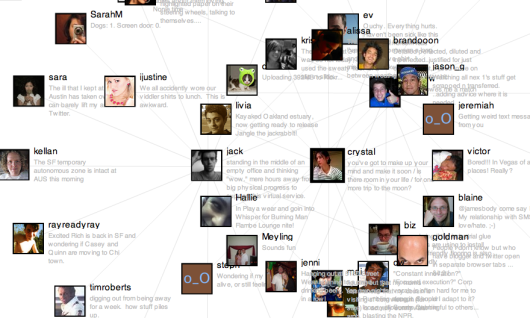
Twitter has created a phenomenon, a phenomenon that brings multitudes of people to one place where people can interact and publish information that could be just nonsense to more important information such as news stories. According to Henry Jenkins, “convergence occurs within the brains of individual consumers and through their social interactions with others. Each of us constructs our own physical mythology from bits and fragments of information extracted from the media flow and transformed into resources through which we make sense of our everyday lives”. Twitter is an example of a convergent medium, with Twitter, you can blog, upload photos, message one another, and interact with people as you would on any other website. With this ability you no longer have to use a Blogger to blog, or use Photobucket to upload pictures, consequently causing a decline in the usage of these types of websites. Our own interactions with others influence our personal mythology and our way of thinking of everyday life, thus creating a convergence in our culture. With this flow of information and the discussions we have about our media today, we gain a sense of collective intelligence. Collective intelligence according to Jenkins “can be seen as an alternative source of media power. We are learning how to use that power through our day-to-day interactions within convergence culture”. This intelligence we have maintained carries us through the tools of the media, and is created from the day to day interactions we maintain with others.

We, as human beings need to feel connected to the world, whether by means of the internet, television, or other technological media. The Internet has made it more convenient to keep in touch with others, providing a constant connection with your friends and family. As explained by Wesch in his video, YouTube gives us a “sense of being just totally overwhelmed by the beauty of the human in front of them. Like people have this really deep profound connection with other humans through YouTube, that maybe they couldn’t experience in everyday life because they’re not allowed to stare, because they’re not allowed to just experience his person as a human being.” Twitter users may not be able to see the beauty of the human in front of them, but Twitter users can experience the beauty of the human mind because what the user writes is more important. Twitter is like YouTube because it too is a medium in which people of similar interests can come together and share information; this gathering of people online creates a community. This online community accepts all types of people, from the average person to celebrities, and in this community they are free to interact with one another. Twitter has no limits to who it accepts into its online community, and as a result it gives people a sense of belonging to the outside world.

According to the article, The Cute Cat Theory of Digital Activism, “with web 2.0, we’ve embraced the idea that people are going to share pictures of their cats, and now we build sophisticated tools to make that easier to do. As a result, we’re creating a wealth of tech that’s extremely helpful for activists. There are twin revolutions going on – the ease of creating content and the ease of sharing it with local and global audiences.” Twitter, is that tool used to share information, news stories, or thoughts to local and global audiences. For instance, CNN has its own Twitter account where they can post the latest news stories, so one can read the news at the click of the mouse instead of waiting until the evening to watch the news. With activism, The American Cancer Society has a Twitter account, where they promote fundraising opportunities, create awareness, and post information on how you can get tested and treated for cancer. Twitter, is not just a website to write a 140 character status but is also a place used for important information such as news and for charity purposes. Twitter, is not only used for senseless talk but instead has a purpose like all mediums, to keep this large world in tune with each other.

Twitter, whether people believe it or not, is an important medium in culture today. It has become a place where people can gather and be with people who share common interests and beliefs as you. Twitter, has become an online community, where people can be continuously connected through their computer. With the invention of the Internet, we have grown accustomed to the ability to share information with local and global audiences. If one day Twitter is replaced by the latest online phenomenon is a different story, but as of now it is a multifaceted medium that the everyday person can tap in to. Without mediums such as YouTube, Facebook, MySpace, and Twitter, we now as a society would feel disconnected to the outside world.

Monday, September 27, 2010
Thursday, September 16, 2010
Subscribe to:
Posts (Atom)